


There is always a temptation when something new comes along to jump straight in. The technology looks clever, the industry is talking about it, and nobody wants to be the last to arrive at the party.
At Equimedia, we prefer to ask a few questions first. Could it help our clients grow? Can we prove it works? And is it worth the investment?
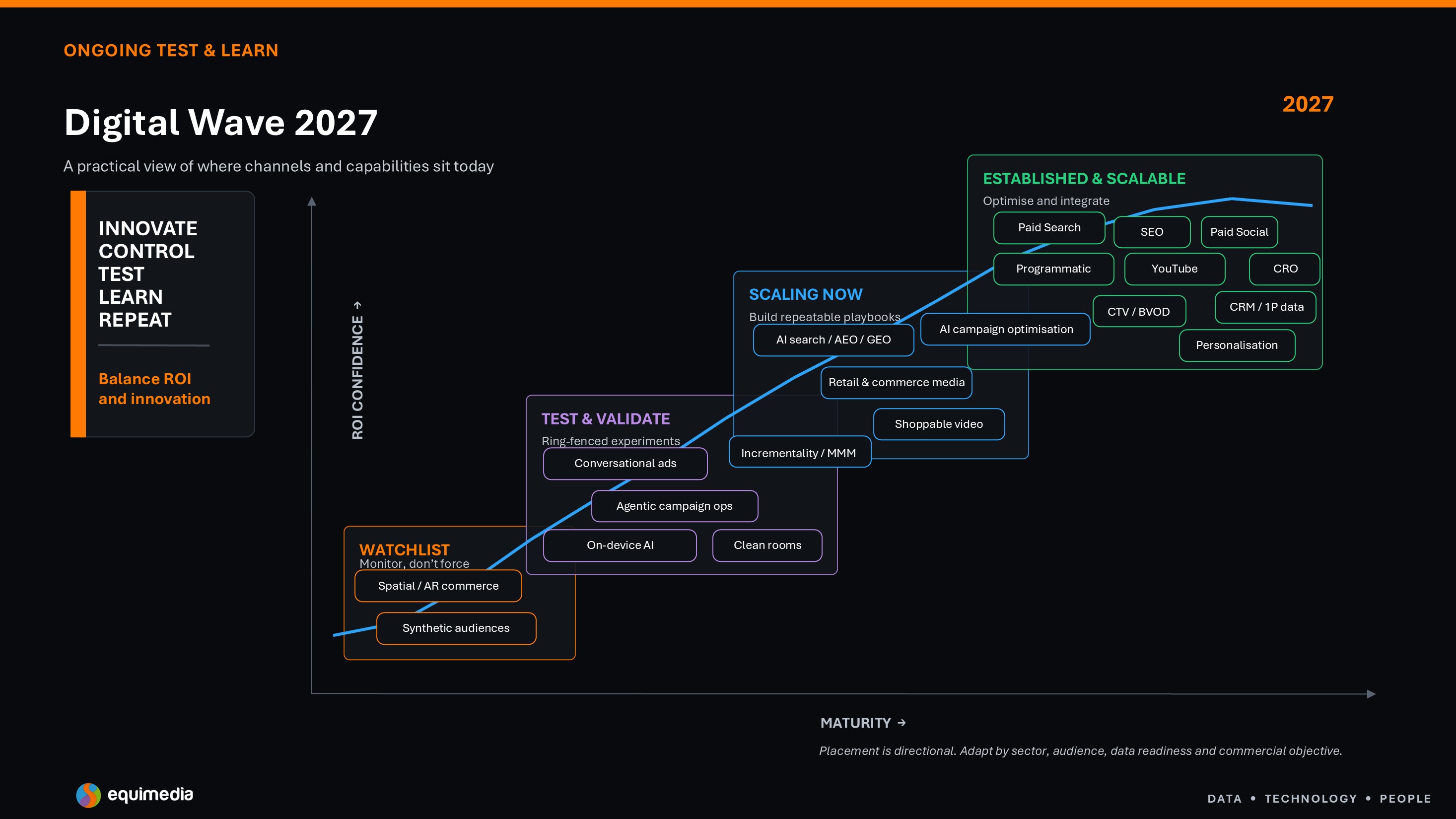
This thinking led us to create our Digital Wave some twenty years ago. It isn't a league table of the latest marketing tools and channels. It is a practical guide to deciding which media channels and tactics we should maximise, which we should improve, which we should test and which still needs more exploration.
As we rush towards 2027, I thought it would be useful to share this year's Digital Wave. This includes plenty of familiar channels, some exciting developments and a few ideas that need more investigation. One of the most interesting is synthetic audiences.
I hear you ask
What are synthetic audiences, and why are we keeping them on our watchlist rather than recommending everyone rush out and use them?
The Digital Wave: knowing where to invest
Our Digital Wave considers two things: how well established a marketing approach is and our confidence in its ability to drive performance and ROI.
That helps us decide what to do next.
- Established and proven: Paid search, SEO, social media advertising, online video, website improvements and customer data. The priority is to keep improving results and make channels work better together.
- Growing opportunities: Connected TV, AI-powered search, retail media and video that lets people shop directly. These deserve more attention, practical experience and a clearer understanding of what works and what doesn’t.
- Worth testing: New advertising formats, secure ways to share data and AI tools that can help manage campaigns. These need carefully planned trials before we invest more heavily.
- On our watchlist: Synthetic audiences and new ways of using augmented reality to sell products. Interesting possibilities, but not yet ready for us to recommend widespread use without further evidence.
The first 3 points fit into the 70/20/10 planning ethos – 70% of budget invested into established and proven channels, 20% to test growing opportunities and 10% to experiment with something brand new.
Of course, the right balance of channels depends on the client’s business. The channel mix that delivers for a bank with a long sales process may be very different from the channel mix that works for an online retailer. This is why we create a Digital Wave for each client based on their industry and objectives bringing together data, technology and people to deliver to their business KPI’s. Data helps us understand what is happening. Technology gives us new ways to reach customers and improve performance. Our people use their experience and judgement to decide what is worth doing, when and how.
The trick is knowing when to act, when to experiment and when to wait.
Synthetic audiences: customers created by AI?
A synthetic audience is a group of computer-generated people designed to represent a real audience.
Using information such as customer records, surveys and research, AI creates simulated people whose opinions can be explored. Businesses can then ask questions about products, advertising messages or new ideas, much as they would ask a focus group.
The attraction is easy to understand. Instead of organising research with real people every time we want to explore an idea, we could use AI to get an initial response quickly and at potentially lower cost.
The technology is developing fast to answer this question;
What if you could test a new product idea and get your audience’s reaction before launching, without bothering real people?
Already, many companies are exploring how simulated audiences might help businesses understand customers and test ideas. There is genuine potential here. We could explore more messages, compare creative ideas and identify promising approaches before spending money on a live campaign.
But there is a catch.
An AI-generated opinion isn't necessarily the same as real customers’ opinions, and neither necessarily tells us what someone will actually buy.
A simulated audience might love an advert. That doesn't guarantee real people will notice it, respond to it or buy the product. We need to know how closely the simulated answers match reality before relying on them to make important business decisions.
Why we are watching, rather than rushing in
New technology often looks most impressive when we are considering its potential. The real test comes when we put it to work.
With synthetic audiences, we need to understand how good the underlying information is, how closely the simulated people resemble the intended customers and whether their answers help us predict real behaviour.
The results may be useful for exploring familiar ideas, but less reliable when dealing with a specialist audience or something completely new. In this scenario, rather than simply assuming that AI will give a reliable answer, further research will be needed to validate outcomes. This doesn't mean synthetic audiences are a bad idea. Far from it. It means we need to establish where they are useful and where their limitations lie.
That is precisely why we have a Digital Wave watchlist.
We don't want to ignore something that could benefit our clients. Equally, we don't want to recommend it simply because everyone is talking about it.
Control, test and learn
At Equimedia, we believe the best way to assess a new opportunity is to test it properly.
That means bringing data, technology and people together in our media planning or website experience teams. Rather than simply trying something new and hoping for the best, we establish what we want to learn, agree how we will measure success and compare the results with what would otherwise have happened.
There are three simple steps.
- Control: know what you are comparing against.
Before changing anything, we need a reliable starting point. That might mean comparing two groups of customers, using different geographical areas or measuring a new approach against an existing campaign. The aim is to understand what would probably have happened without the change. Otherwise, we risk giving the new idea credit for results we would have achieved anyway.
- Test: start small and set clear goals
We then agree what we want to test, how much we will spend, how long the test will run and what success looks like. For synthetic audiences, we might start by asking AI to compare several advertising messages or creative ideas. We could then check its recommendations with real customers and, where appropriate, run a small advertising campaign to see how people actually respond. The important thing is to keep the test focused. If we change too many things at once, it becomes difficult to understand what made the difference.
- Learn: use the results to make better decisions
Finally, we compare the results and decide what to do next.
Did the new approach improve performance?
Was the improvement worth the cost?
Can we trust the results enough to invest more?
A test doesn't have to succeed to be valuable. Finding out that something doesn't work can save a business from making a much larger, more expensive mistake.
And if the first results look promising, we shouldn't automatically assume they will hold up everywhere. We need to understand whether the improvement is genuine and whether it is likely to continue when we spend more.
The aim isn't to run more tests. It is to make better decisions because of what we learn.
Where synthetic audiences might fit
Our starting point would be to use synthetic audiences alongside real customer insight, rather than as a replacement for it. For example, we might use AI to explore different advertising messages, identify possible customer concerns or narrow down a long list of creative ideas. Our team could then review those suggestions, test the strongest options with real customers and measure their performance in a live campaign.
Each plays a different role:
- Data helps us understand customers and measure what happens.
- Technology helps us explore ideas and work more efficiently.
- People bring experience, challenge assumptions and make sound commercial decisions.
This is the strength of combining all three. Technology can help us move faster, but we still need evidence and human judgement to decide whether we are moving in the right direction.
For businesses considering synthetic audiences, we would recommend five simple rules:
- Start with a clear question. Decide what you want to find out, such as which advertising message is most promising.
- Set a limit. Agree the budget, timeframe and measures of success before starting.
- Check the answers. Compare AI's predictions with real customer feedback or actual campaign results.
- Keep people involved. Use AI to support decisions, not make them unquestioningly.
- Invest more only when the evidence supports it. A promising first result is a reason to investigate further, not a reason to spend without limits.
Controlled testing will improve your media results
The Equimedia Digital Wave 2027 helps businesses decide where to focus their marketing investment today, while keeping an eye on what might be useful tomorrow.
Some approaches are well established and ready for further improvement. Others offer new opportunities that need to be explored. And some, including synthetic audiences, are promising enough to watch but still need to prove their value.
Our approach remains the same: combine data, technology and people to plan carefully, test fairly and learn from the results. The point isn't to use the latest technology for the sake of it. It is to help our clients make better decisions about where their money goes and what it delivers. Synthetic audiences may become a valuable part of that picture. If the evidence shows that they help us make better decisions and improve results, we will give them a bigger role. Until then, we are happy to dip a toe in the water rather than build the holiday home on the strength of a promising forecast.
Want to understand where controlled testing could help you improve your media results and what a Digital Wave might look like for your business in 2027? Get in touch with us. We would be delighted to explore the opportunities, agree what success looks like and work out how to prove what is worth investing in.


Newsletter sign up
Post Information
| Author | Amisha Rathod |
| Channel | Media |