


Paid media has long been the backbone of digital growth strategy. Traditionally, its role was straightforward: reach new audiences, insert your brand into consideration early, and generate downstream impact across lower-funnel channels.
However, as AI search engines and conversational assistants fundamentally alter user behaviour, paid media’s role has evolved. It is no longer just a driver of direct clicks; it is a critical touchpoint within an AI-dominated ecosystem.
Paid media as an AI touchpoint
In an environment where AI tools summarise information directly on the search engine results page (SERP) or answer user prompts conversationally, the journey from curiosity to conversion is rarely linear. Paid media must pivot to address three core consequences:
- Offsetting Zero-Click Searches: With Large Language Models (LLMs) answering queries right on the results page, organic clicks for mid-funnel queries are declining. Paid media provides a direct pathway to capture user attention and drive valuable, qualified traffic to your site despite zero-click barriers.
- Reinforcing Brand Messaging: Generative AI models synthesise web data to surface brand information to users. Paid campaigns maintain consistent, authoritative messaging across channels, reinforcing brand narratives that AI engines train on and index.
- Influencing AI Visibility: Paid visibility directly boosts brand query volume and online mentions. As AI models rely on a brand’s overall digital footprint, entity relevance, and brand search velocity to determine which brands to recommend, paid media actively feeds the ecosystem that shapes AI outputs.
Redefining "creating demand" in an AI world
Creating demand used to mean generating interest through display, social, or video ads and waiting for a user to enter a traditional search funnel. Today, creating demand means cultivating active exploration within AI environments.
When consumers encounter a problem, their first step is often a conversational prompt (e.g., "What is the best solution for X?" or "Compare top providers for Y"). Brands must generate sufficient top-of-mind awareness so that users explicitly include the brand name in their prompts or recognise it immediately when an AI assistant recommends it. Paid media acts as the spark that triggers this AI-driven discovery and conversation.
Rethinking Measurement: Bringing Back the Modern ‘Misc.’ source code
As zero-click interactions rise and user journeys become increasingly dark, direct last-click attribution models are breaking down.
In our recent blog, Is Our Zero-Click World Heralding The Return Of The 'Misc.' Code?, we explored how direct response marketers historically handled unobservable touchpoints. In direct mail and call centres, teams used a "miscellaneous" or "unallocated" response bucket to capture invisible marketing impact without pretending every single conversion could be mapped directly to a specific code.
Modern measurement requires a similar mindset shift:
- Accept Imperfect Visibility: Stop trying to tether every sale to a single tracked click in a cookie-less, zero-click world.
- Institute Modelled Unattributed Contribution: Integrate a formal ‘Misc.’ bucket in reporting—backed by Media Mix Modelling (MMM), econometrics, and incrementality experiments—to quantify untracked zero-click and AI influence.
- Focus on Blended Incremental Value: Evaluate how paid media shifts overall brand demand and total revenue rather than relying solely on platform-reported conversions.
When it comes to measurement, the most crucial consideration is that decisions are based on accurate data. If data is incorrect all decisions rooted in this data will be flawed. Inaccurate data is like a faulty compass: you can follow it with confidence and still end up heading in the wrong direction.
Evolving our framework for media planning
To help clients navigate this changing landscape, we have revisited our media channel planning framework. Our previous framework referenced two types of media:
- Market Making: Channels which operate at the mid-to-upper funnel and create demand for the product or service
- Market Taking: Channels which harvest the demand and typically drive the conversion or lead
Whilst this still stands today, the framework has evolved into something that recognises the dominance of AI and the emerging opportunities this brings.
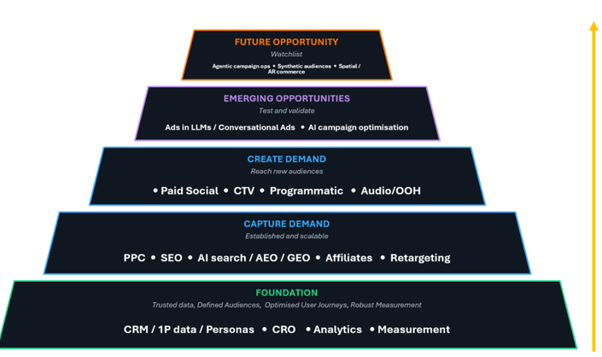
- Foundation. Effective paid media starts with strong foundations. Getting these elements in place before investing, gives activity a clear direction, the best chance of succeeding and ensures accurate measurement removes the guesswork and accurately directs future decisions.
- Capture Demand. Convert existing demand into action through ‘market-taking’ channels, which typically deliver the most efficient performance.
- Create Demand. Build interest and generate new demand through ‘market-making’ channels that reach new audiences.
- Emerging Opportunities. Test and validate new channels and tactics in a controlled way before deciding whether to make them part of ongoing activity.
- Future Opportunities. Channels and tactics which are not yet ready for testing but are on our watchlist.
Equimedia’s three pillars of Data, Technology & People are at the heart of everything we do, including this media planning framework. Data forms a key part of the foundation, technology underpins all areas and people are crucial in drawing out insight and forming a strategy that’s right for each client.
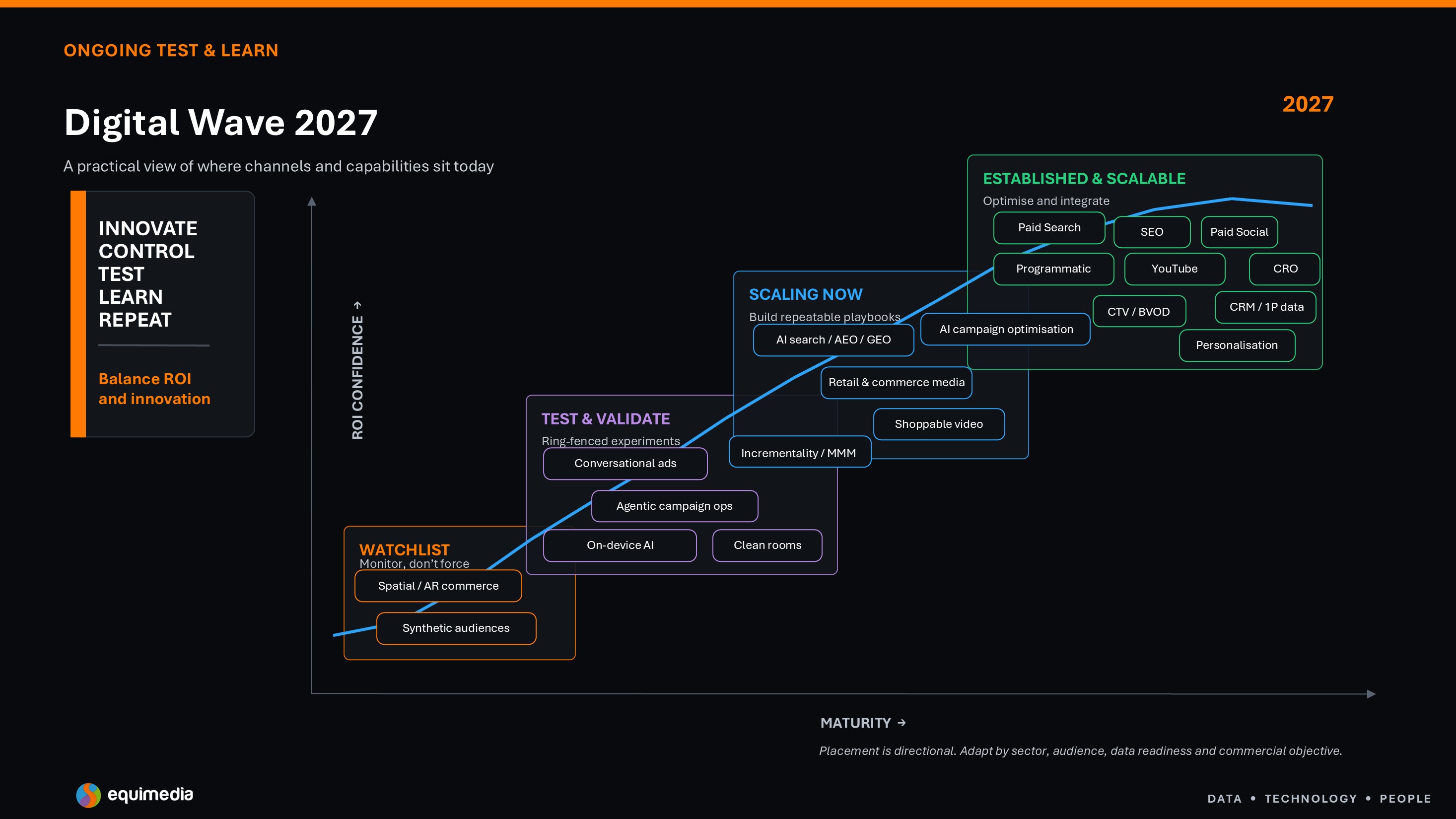
Directly linked to the emerging and future opportunities is our ‘Digital Wave’ which maps media channels based on their maturity and ability to drive proven ROI.
What does this all mean for brands?
Paid media remains essential in the AI era because brands need to be known before they can be considered. As discovery moves beyond traditional search results into AI-led conversations, its role extends beyond winning the next click: it builds awareness, creates reasons to explore and keeps brands front of mind.
Alongside capturing existing demand, paid media helps generate the interest that prompts customers to seek out a brand by name or recognise it when exploring their options. Its value should therefore be judged not just by the clicks it delivers, but by its contribution to demand and business growth—even when the full journey cannot be tracked.
Are you ready to rethink your media strategy for an AI-shaped world? Contact Equimedia to explore how you can balance demand creation with demand capture, test emerging opportunities and build a clearer picture of your marketing’s contribution to growth. Let’s start with your goals and shape a plan for what comes next.


Newsletter sign up
Post Information
| Author | Amisha Rathod |
| Channel | Media |